When faced with the decision to buy a house, most people's first reaction is to open a calculator and calculate "how much will the monthly payment be?" But in reality, the monthly payment is just a static number; it cannot answer the truly crucial question:How will this long-term debt reshape your cash flow? Will it limit your career options? Is your asset allocation resilient enough in the face of extreme volatility?
WealthCompass is not a simple repayment calculation tool, but rather a..."Professional Intelligent Wealth Advisor"It upgrades home-buying decisions from simple addition and subtraction of numbers to a visualized and quantifiable analytical loop—from the dynamic fluctuations of the LPR interest rate to the NPV (Net Present Value) model comparing rent and buy, and then to stress testing of household balance sheets, aiming to replace emotional impulses with rigorous data logic.
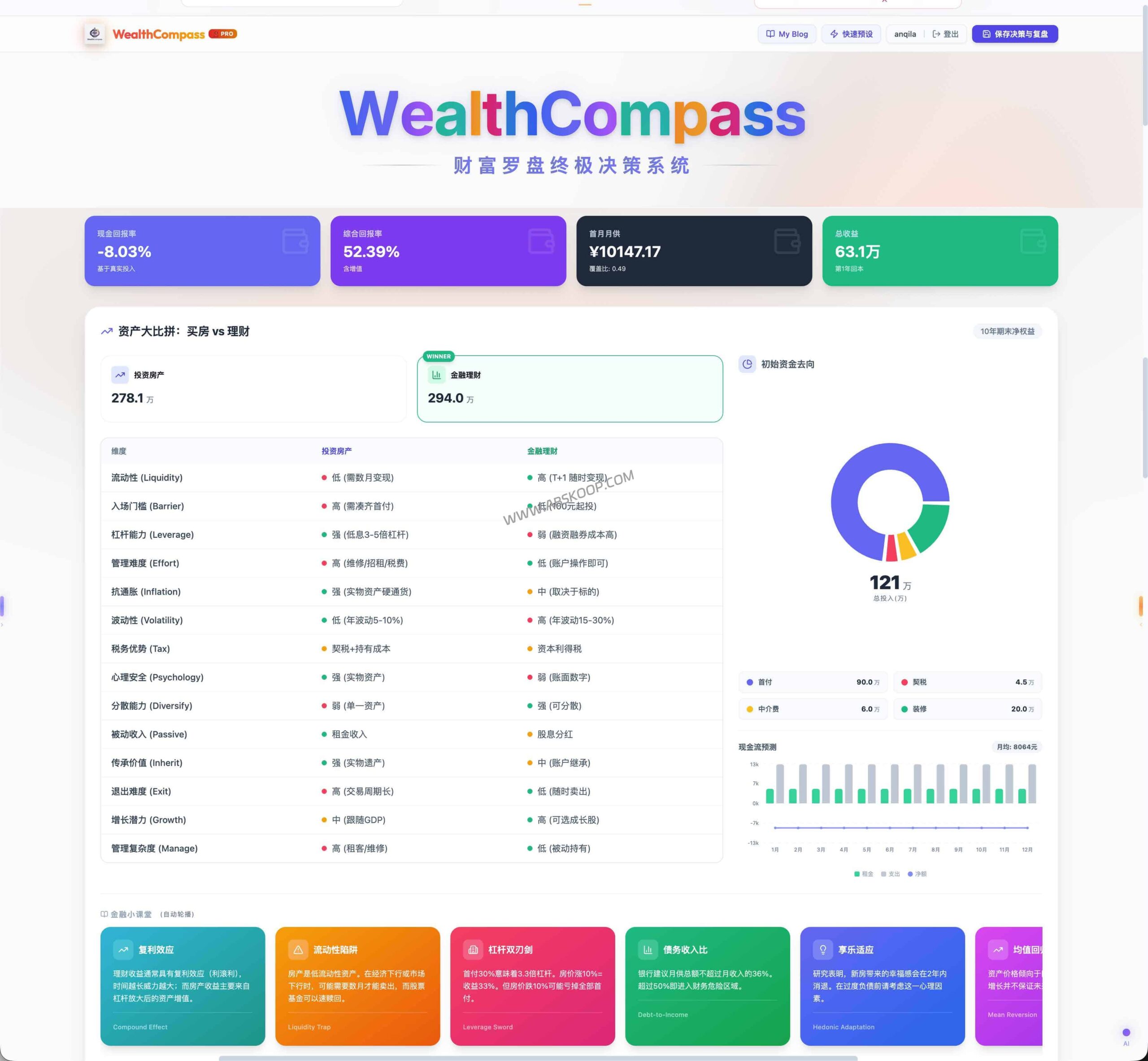
Who needs to upgrade from "calculating monthly payments" to "making decisions"?
If your financial situation falls into any of the following categories, WealthCompass will provide you with deeper decision support:
- High-income earners but cash flow sensitive individuals: Despite the attractive monthly salary, it is necessary to accurately assess whether mortgage pressure will reduce flexibility for future career transitions.
- Entrepreneurs/freelancers with fluctuating income: It is necessary to verify through models whether the cash flow can still support repayment in the event of a "black swan" event.
- Family financial coordinator: Mortgage payments need to be integrated with children's education funds, retirement planning, and insurance coverage. Balance Sheet To conduct overall planning.
- Rational investors who pursue the ultimate ROI: focus on Opportunity CostThis requires that the destination of every fund be logically explainable and traceable.
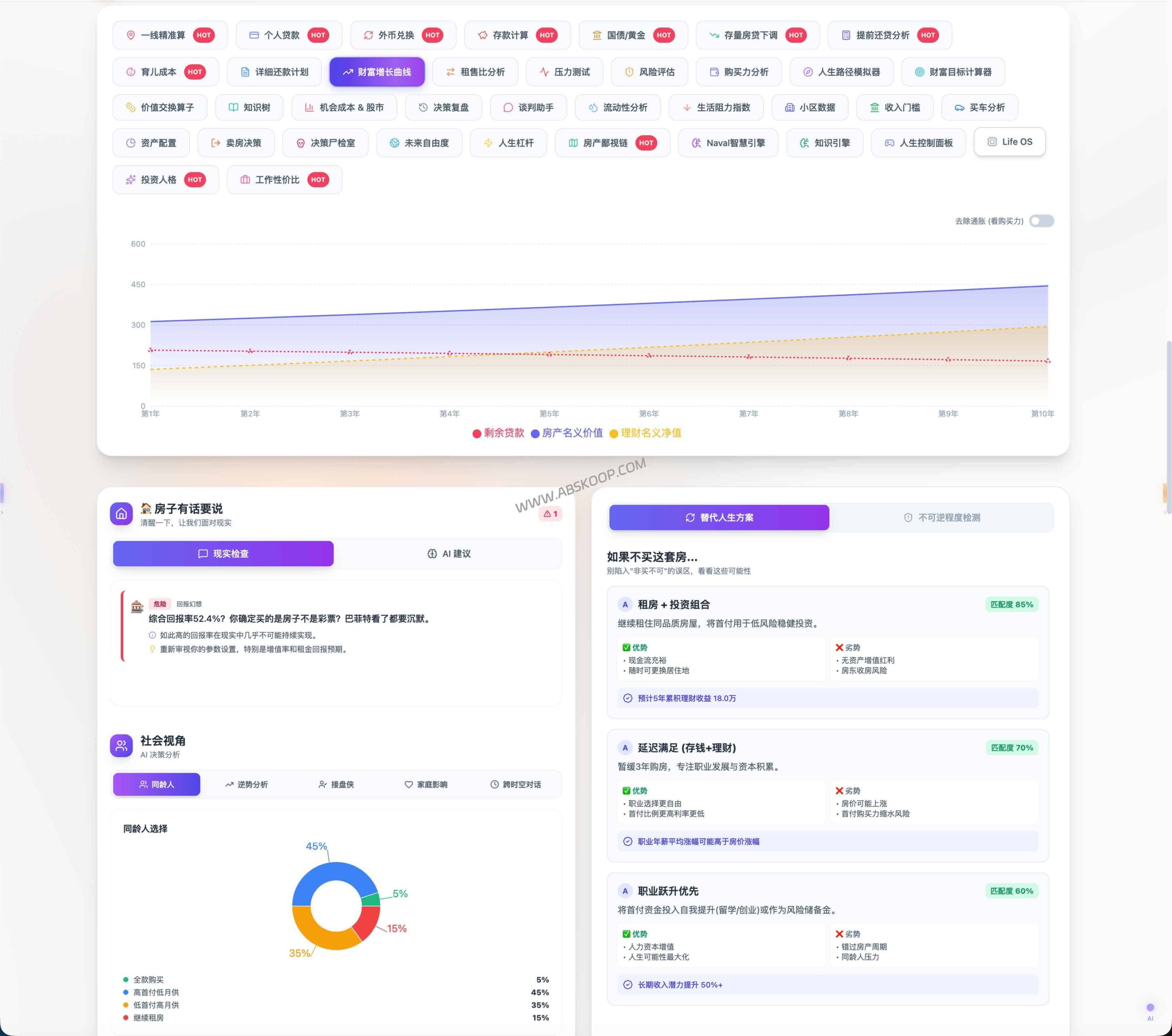
Core Competency Breakdown: Building a Closed Loop for Financial Decision-Making
1. Mortgage calculation based on interest rate and structure
In addition to basic monthly payment results, the system reveals long-term financial impacts through charts. By observing changes in the "interest rate ratio" and "principal recovery speed," users can gain a more intuitive understanding of the cost of capital, rather than being misled by a single number.
- LPR dynamic analysis: Simulate different spreads to calculate cost differences under real-world interest rate conditions.
- Repayment model comparison: A one-click comparison of the impact of "equal principal and interest payments" and "equal principal payments" on the cost of capital occupation.
- Visualized debriefing: Charting total interest against monthly details reduces communication costs among family members.
2. Early repayment: From "saving interest" to "capital efficiency"
The misconception about prepaying a loan is that you only look at "how much interest you save" while ignoring the financial aspects. Alternative YieldWealthCompass translates this into a quantitative choice: Is it more worthwhile to use this money to pay off loans, or is it safer to keep it for investment or emergency reserves?
- Quantify the compound interest effect generated by different repayment times and amounts.
- Assess whether prepaying a loan would excessively deplete the "cash flow safety cushion".
3. Rent vs. Buy: Quantifying Opportunity Cost Using NPV
Whether to rent or buy a property should not be determined by personal stance, but by algorithms. We consider factors such as mortgage costs, rental growth rates, expected property appreciation, taxes, and... Investment opportunity cost(e.g., S&P 500 returns), utilizing financial engineering techniques. NPV (Net Present Value) The method compares different paths on the same dimension.
Core logic: The sunk costs of buying a house are offset against the long-term expenses of renting, and the funds tied up in the down payment are converted into opportunity costs to avoid underestimating hidden costs.
4. Stress testing: Verifying financial antifragility
The real risks lie in extreme scenarios. This module tests user experience by simulating negative scenarios such as soaring interest rates, falling housing prices, and income disruption. Financial resilience。
- Work backward from the "worst-case scenario" to deduce a reasonable monthly payment limit and down payment strategy.
- Accurately identify cash flow breakpoints and debt ratio red lines, etc. High-risk area。
5. Human Capital Quantification: Evaluating the Cost-Effectiveness of Work
A variable often overlooked in mortgage decisions is Human CapitalWithout quantifying true hourly wages, the quality of benefits, and job stability, a mortgage becomes a gamble. This tool helps users upgrade simple "income figures" into "income certainty" analysis.
Three Golden Standards for High-Value Home Buying Decisions
When using WealthCompass for analysis, it is recommended to focus on the following dimensions:
- Cash flow priority: The focus should not be on "whether it can be repaid", but on "whether it can maintain its quality of life and retain the ability to invest against risks after repayment".
- Opportunity cost can be explained: The ROI only makes sense if you clearly define the other compound interest paths that the down payment funds are forgone.
- Clear risk control boundaries: It relies on the bottom line defined by stress tests, rather than on a "feeling" of interest rate or housing price trends.
Privacy Commitment: Local computing, seamless decision-making
WealthCompass uses a Client-Side architecture: All calculations are performed within your local browser. Sensitive financial data such as salaries and loan amounts are never uploaded to the server. This "low-friction, high-privacy" design ensures that users can confidently conduct repeated calculations and make private plans.
📌 Summary of Key Decision-Making Points
Shifting home buying from a "gut feeling" to a "calculable" professional decision:
- Look at the structure: Gain insights into long-term interest costs by understanding the Loan Prime Rate (LPR) and repayment methods.
- Seeking efficiency: By simulating early repayment, we can find the optimal solution for fund utilization.
- Comparison of values: The NPV model is used to uniformly measure the opportunity cost of renting and buying.
- Uphold the bottom line: Stress testing helps ensure financial security during extreme market conditions.
👉 Start planning now:WealthCompass | Smart Wealth Advisor
