If you want to study Buffett's investment logic, the most direct way is to download those thick collections of shareholder letters in PDF format. But you'll soon find that this method of reading is extremely inefficient: core concepts like "intrinsic value" or "moat" are often scattered across letters spanning decades. To trace the evolution of a particular investment decision, you can only resort to repeatedly using Ctrl+F—a "needle in a haystack" approach—through a massive amount of documents.
To address this pain point, a project called... "Buffett Shareholder Letters Knowledge Base" The project was born out of this need. It reconstructs decades of plain text data into an interconnected knowledge network.
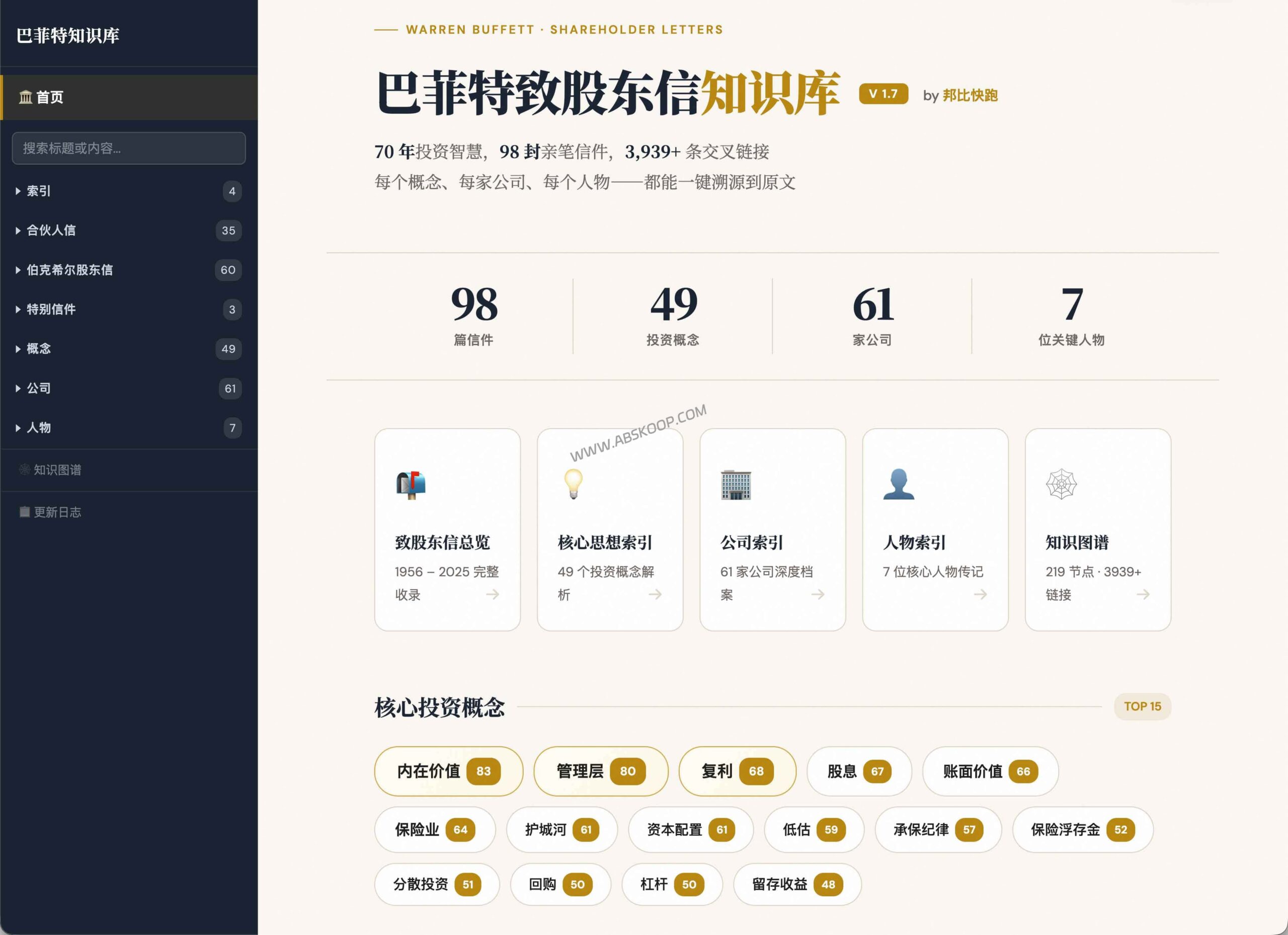
Currently, the database contains over 98 letters and has built more than 4,700 cross-links. Most impressively, its construction efficiency is remarkable: a Chinese developer, using Claude Code and deploying five agents in parallel, completed the translation, concept extraction, metadata generation, and full-site deployment of 81 letters within two days. In this process, AI acts not only as a translator but also as a structured processor capable of automatically extracting companies, individuals, and core concepts and establishing bidirectional links.
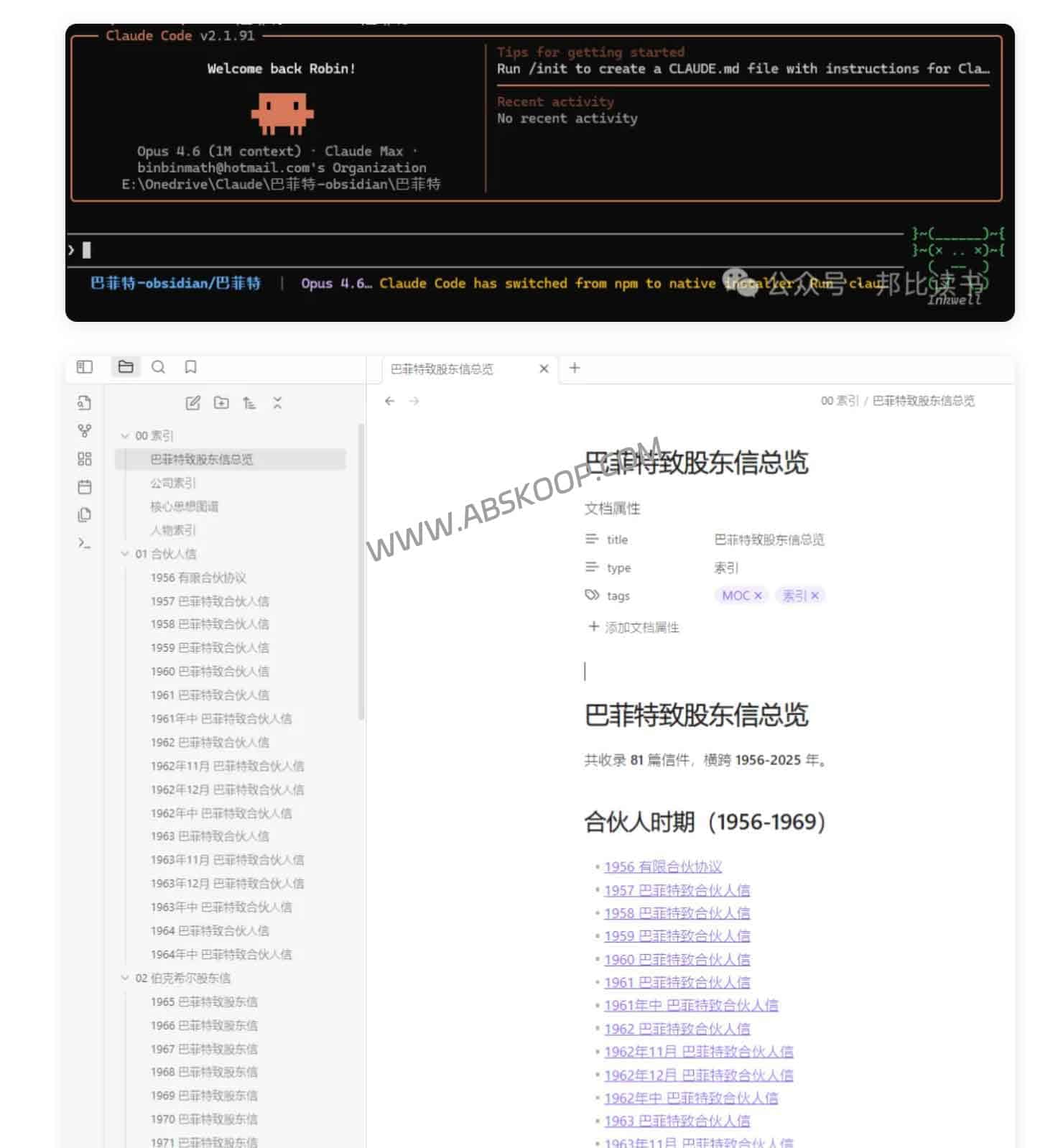
Upgrade from "linear reading" to "network retrieval"
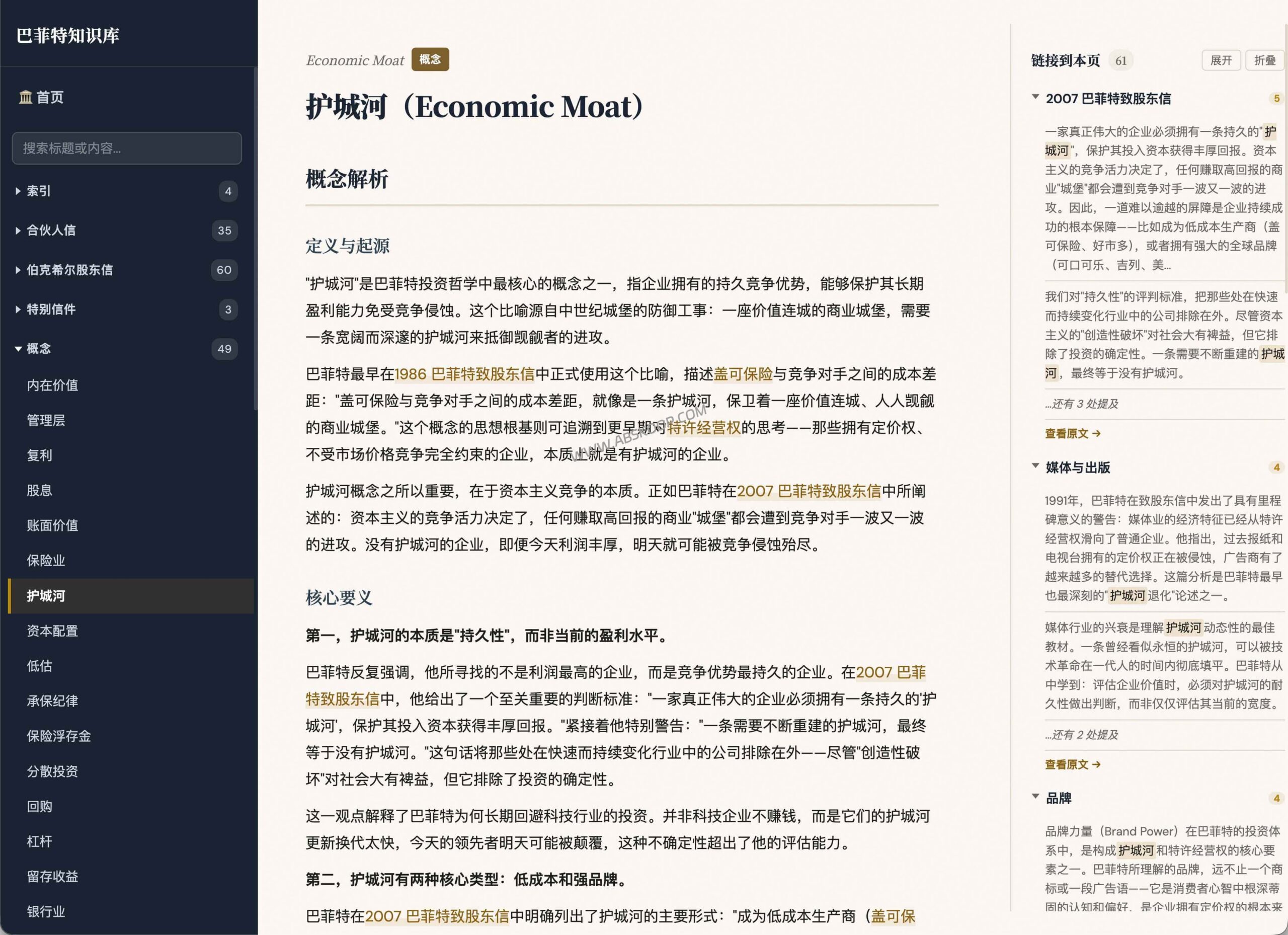
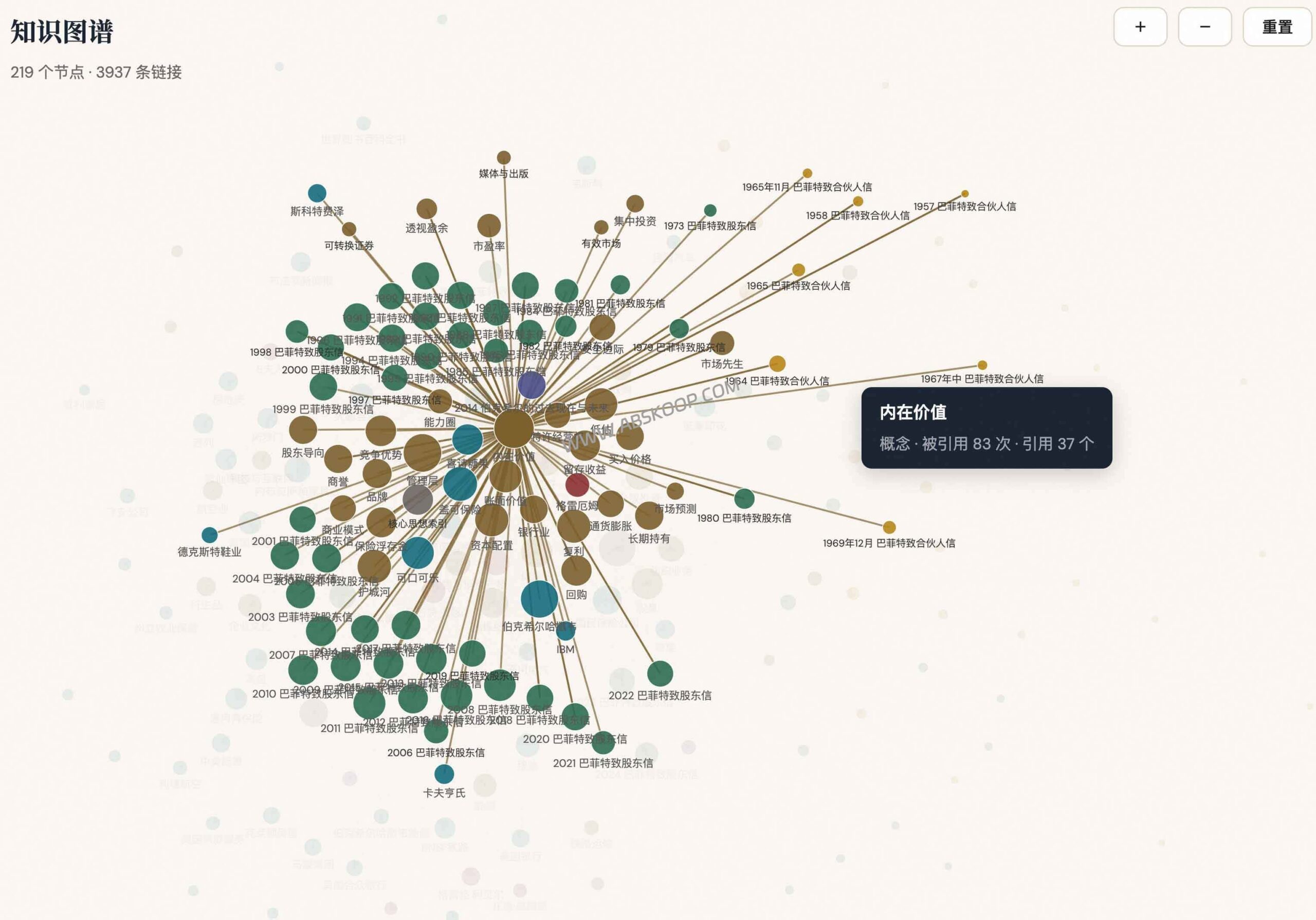
Compared to traditional PDF collections, this knowledge base deconstructs the data into... "Concept + Company + Person" The three-layer structure creates hundreds of jumpable knowledge nodes. This structured approach makes much of the hidden logic intuitive:
- Concept Origin:When you look at the "moat" page, you'll find that Buffett didn't officially use the term until 1995; before that, he used "franchise" to express the same logic.
- Timeline filtering:By filtering through time, we can clearly observe Buffett's analysis of his investment mistakes at different stages.
- Original quotes compilation:With the D3.js knowledge graph, the search function has changed from "finding the entire letter" to "finding a specific paragraph". For example, clicking on "Coca-Cola" will not show you an encyclopedia entry, but rather a collection of all of Warren Buffett's original quotes about the company over the past 40 years.
Practical Examples of AI Workflow
This project is not just a search tool, but also demonstrates a paradigm for efficient AI processing of long documents:AI is responsible for performing the heavy manual labor.(such as cross-document association, format standardization, and preliminary translation), while Developers are responsible for defining rules, sampling quality checks, and mining insights.This workflow can be quickly adapted to scenarios requiring deep structuring, such as industry research report analysis, policy document review, or legal case file organization.
- This database is intended to provide information retrieval, not to offer specific "money-making guides" or investment advice.
- Since this is an AI-translated and compiled version, if rigorous academic citations are involved, please use this database as a search tool and ultimately check the original English text on the Berkshire Hathaway website.
Usage limitations and objective constraints
Before using it as your primary database, users should keep the following points in mind:
- Interaction logic:The current experience is an "index-based navigation" experience that relies on node and graph navigation and lacks traditional global fuzzy search functionality.
- Translation accuracy:Despite manual sampling, the massive amount of text processed by AI may have subtle translation errors when dealing with complex metaphors or deep contexts.
- Update frequency:The project is maintained by an individual, and the speed at which new emails are added depends on the developer's workload.
Further Reading:Explore more AI workflow tools to improve the efficiency of processing long data.
Resource entry and review
Disclaimer:This project is a free resource library compiled by third-party developers based on publicly available literature, and does not provide any investment advice. This site only provides objective observations from the perspective of tool efficiency and AI workflow implementation, and does not endorse the absolute accuracy of the content; users are advised to exercise their own judgment.
