Foreign Trade 0-1 Quick Learning Course Guide
This course aims to help domestic trade professionals quickly build a comprehensive knowledge framework as they transition to international trade. The course avoids abstract theories and focuses on... Real business processes With this as the main theme, the course focuses on solving key challenges, from industry assessment and supply chain integration to customer development and risk control, helping participants build an actionable practical framework in a short period of time.
Applicable Scenarios
- Enterprise Transformation:Owners or managers of domestic trade enterprises who plan to expand into overseas markets need to quickly clarify their business logic.
- Starting a business:Individuals who want to try starting a foreign trade business using the SOHO model but lack systematic guidance.
- Cognitive Upgrade:This is for beginners who are interested in foreign trade and hope to reduce trial-and-error costs by learning systematically before actually investing resources.
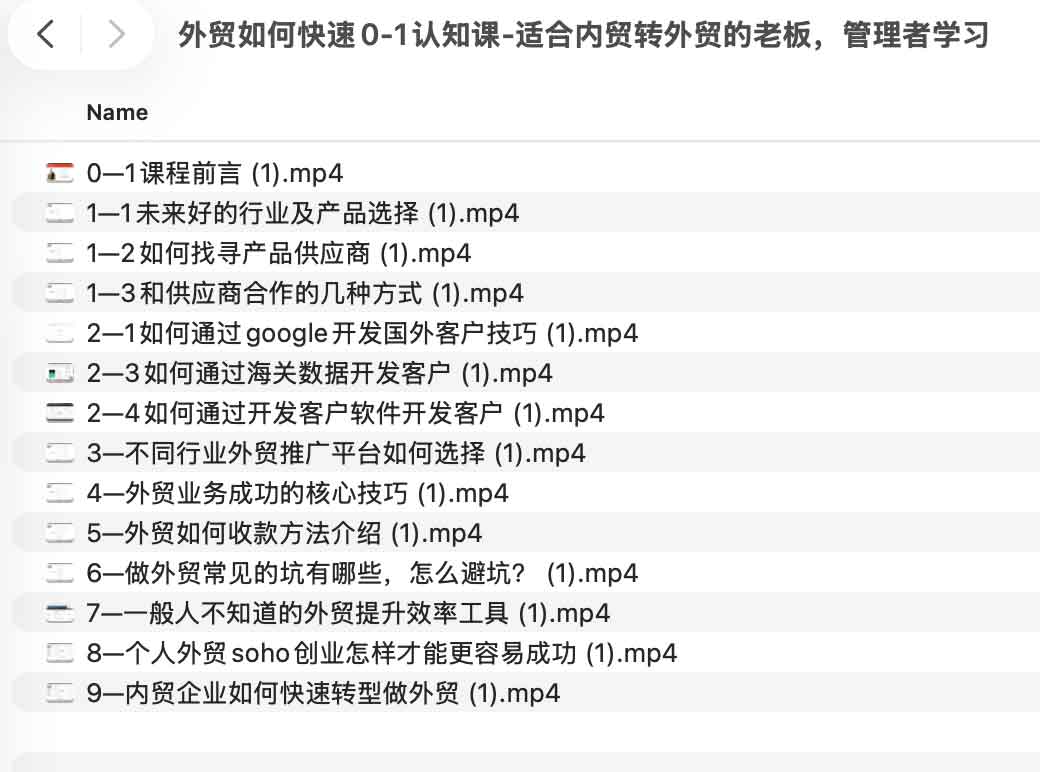
Course Syllabus
1. Basic cognition and logic
- Analysis of the overall starting path for foreign trade from 0 to 1
- In-depth comparison: The core differences in business logic between domestic and foreign trade
2. Product Selection and Supply Chain
- Industry assessment:Analysis of Potential Foreign Trade Industries and Product Selection Strategies
- Supplier Management:Comparison of mainstream supplier acquisition channels and the advantages and disadvantages of different cooperation models
3. Customer development and promotion channels
- Precise customer acquisition:Practical approaches to Google search techniques, customs data mining, and software development.
- Channel selection:Analyze the appropriate promotional platforms for different industries and formulate phased channel strategies.
4. Core Competencies and Risk Control
- Business execution:Key understanding and implementation points for success in foreign trade
- Fund security:Analysis of mainstream payment methods and establishment of basic risk control system
5. Tips for Avoiding Pitfalls and Productivity Tools
- Risk avoidance:Analysis of common pitfalls in foreign trade and corresponding solutions
- Efficiency improvement:Share practical tools that can directly improve business and management efficiency.
6. Transformation Path Analysis
- Feasibility assessment of the individual SOHO model
- Implementation plan for the rapid transformation of domestic trade enterprises to foreign trade
Core benefits
After completing this course, you will gain a systematic understanding of foreign trade, enabling you to independently determine whether you are suited to enter the foreign trade field and clearly define your goals. Starting order andKey links。
By mastering the processes of product selection, supplier cooperation, customer development, and promotion and payment collection, you will significantly improve decision-making efficiency, avoid repeating mistakes in blind investment, and achieve a business cold start at the lowest cost.
How to obtain
Learning resource address:Click to access Quark Cloud Drive download.
