What is Vibe Coding?
Vibe Coding is not simply AI-assisted programming, but a suite of technologies that... "Planning-driven" and "Context fixed" A deeply integrated, systematic development process. It aims to transform AI from a tool for randomly generating code into an auditable and maintainable pipeline execution end. By building modular designs and precise prompt words, developers can leverage top-tier models such as Claude 4.5 or GPT-5.1-Codex to achieve an automated closed loop from creative conception to final implementation.
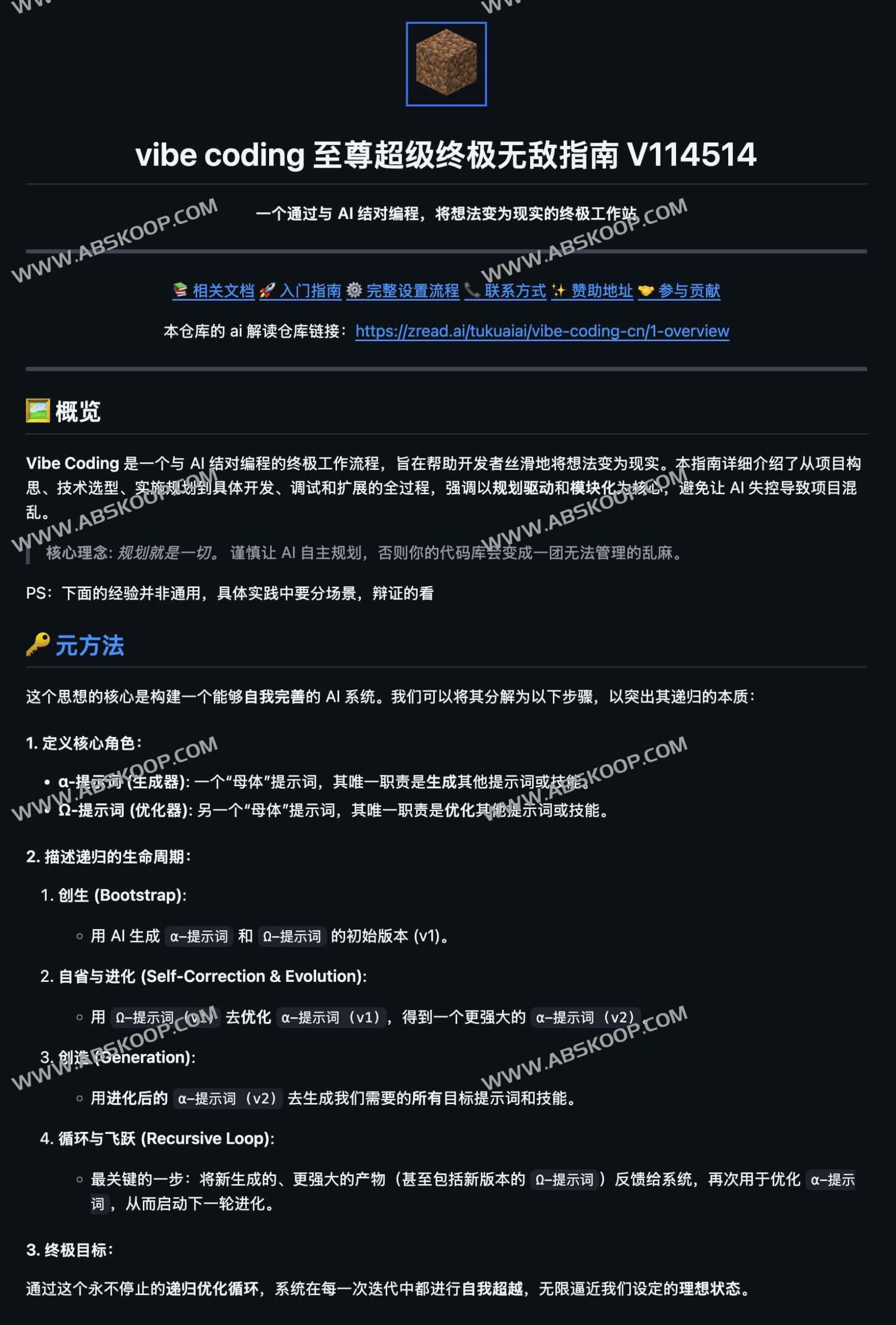
Core Philosophy: Planning First
Vibe Coding believes that AI should not be "laissez-faire" but should be embedded in a rigorous, goal-oriented process. Its core logic is:
- Control of planning authority: Humans define clear goals to prevent logical biases from occurring when AI plans autonomously.
- Optimize the context: Output quality depends on the quality of input, emphasizing the construction of high-quality contexts.
- Evolution of prompt words: Establish a self-evolving system for generating prompts from prompt words.
- Purpose-oriented: All development actions must serve the intended purpose, eliminating ineffective and redundant work.
Technical Methodology: Tao, Law, Technique, and Tool
The Way (Principle Level)
- Full AI-enabled: We will resolutely eliminate human intervention in any process that can be handled by AI.
- Guided questioning: Guide the task by following the logical chain of "what is it? why is it? how to do it?"
- Structure first: Prioritize building system architecture rather than writing code to avoid technical debt at its source.
- Accurate reproduction: Improve debugging efficiency by asking precise questions and reproducing problems.
Law (Design Code)
- Orthogonality: Functional modules do not interfere with each other, avoiding reinventing the wheel.
- Agile Iteration: We adhere to the principles of prioritizing interfaces and clearly defining responsibilities, and adopt an iterative approach of taking small, rapid steps.
- Document is context: Incorporate document collaboration into the planning phase, making it a real-time reference for AI execution.
Techniques (Execution Skills)
- Defining boundaries: Clearly inform the AI which code blocks can be modified and which must remain unchanged.
- Comparison and debugging: AI debugging is based on "expected results vs. actual results + minimum reproducibility path".
- Review mechanism: Test cases and assertions are written by AI, and humans are responsible for the final review and judgment.
Tools (toolchain)
| category | Recommended tools | Core Uses |
|---|---|---|
| IDE | Cursor | An intuitive and AI-friendly editor |
| Environmental Management | .venv | Python environment isolation and configuration conflict resolution |
| Core Model | Claude Opus 4.5/GPT-5.1-Codex | Handle large project logic and ensure delivery stability |
| CLI tools | Gemini CLI / Kiro / Droid | Execution scripts, automated document organization |
| Local deployment | Ollama | Local CLI Management and Execution of Open Source Models |
| Enhanced prompts | Augment | One-click generation of prompt words and sentence optimization |
| Knowledge internalization | Zread / NotebookLM | Structured reading of GitHub repositories and resources |
| Terminal Enhancement | Warp / tmux / nvim / LazyVim | Improve the remote development and command-line operation experience |
| database | DBeaver | Engineering-level multi-database connection management |
Model capability rating
Based on actual development experience, the current mainstream models are divided into three tiers (for complex tasks, it is recommended to choose the first-tier model first):
| grade | Recommendation Model |
|---|---|
| First-class (top-tier) | codex-5.1-max-xhigh, claude-opus-4.5-xhigh, gpt-5.2-xhigh |
| Second Class (Excellent) | claude-sonnet-4.5, kimi-k2-thinking, minimax-m2, glm-4.6, gemini-3.0-pro |
| Third class (available) | qwen3, SWE, grok4 |
Resource Acquisition
A detailed Chinese guide and project demo are available as open source on GitHub. Feel free to visit:
🔗 https://github.com/tukuaiai/vibe-coding-cn
