🚀 Detailed Explanation of Advanced Practical Course on Python Distributed Web Scraping and Reverse Engineering
This course aims to provide developers with a complete data acquisition chain, from basic beginners to enterprise-level applications. It not only covers fundamental aspects such as HTTP requests and data parsing, but also delves into distributed architecture, complex login simulation, CAPTCHA recognition, and advanced reverse engineering, helping learners build a rigorous, practice-oriented technical system.
Core technology stack: Requests, Scrapy, Scrapy-Redis, MongoDB, Redis, Selenium, OpenCV, OCR, etc.
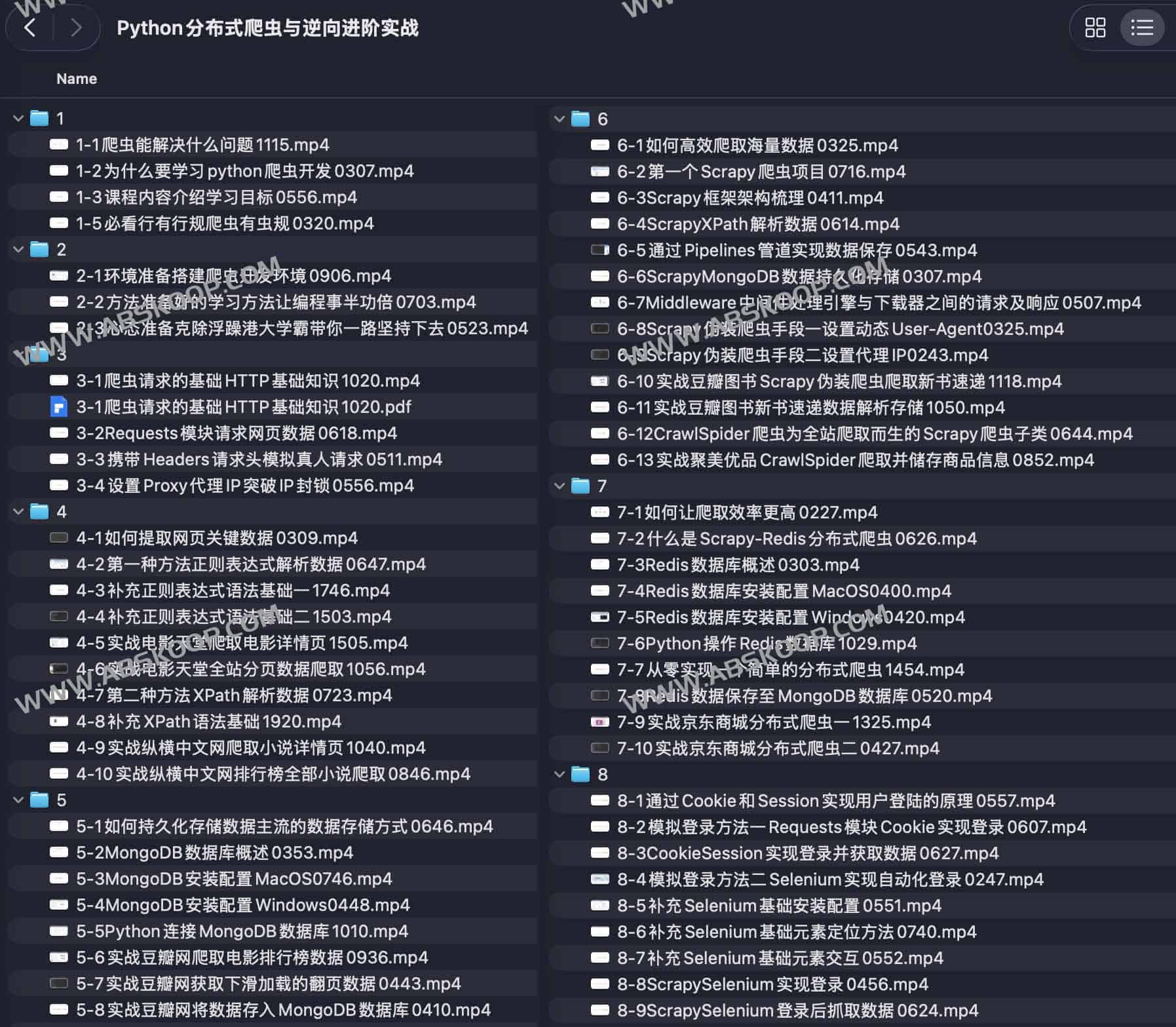
🧩 Course Module Structure
1. Basic understanding and environment setup
Before starting coding, establish a systematic understanding, clarifying the industry value, application scenarios, and legal regulations of data collection. Simultaneously, configure the development environment and master efficient learning paths and mindset.
2. Data Acquisition and Analysis Technologies
- HTTP communication: Gain a deep understanding of request/response structures, use Requests to simulate browser behavior, and bypass IP restrictions through header spoofing and proxying.
- Precise Analysis: This course utilizes regular expressions and XPath to extract structured data, covering practical applications of paginated data scraping for various types of content, including movies and novels.
3. Storage Solutions and Framework Practice
- Persistent storage: Learn how to install and connect to MongoDB to achieve efficient storage of data such as Douban rankings.
- Scrapy framework: Master the core architecture, Pipelines storage, Middleware, and UA pool masquerading; practice full-site crawling through projects such as Jumei.com.
4. Distributed architecture upgrade
For large-scale data collection, introduce Scrapy-RedisLearn Redis data structures and distributed scheduling mechanisms, and use JD.com as an example to build a high-concurrency, scalable data collection system.
5. Automated login and CAPTCHA bypass
- Simulated login: This paper analyzes the principles of Cookie/Session and combines Requests and Selenium to implement an automated login process.
- Image processing: Using OpenCV for pixel processing, binarization, and morphological operations lays the foundation for CAPTCHA recognition.
- OCR recognition: By combining Baidu OCR cloud services with slider trajectory algorithms, we can overcome complex CAPTCHAs.
- AI Model: EasyDL is used for CAPTCHA sample collection, annotation, and model training to achieve automated API recognition.
6. Anti-crawling strategies and reverse engineering
To tackle challenging target websites, learn how to analyze encryption methods such as Base64, Unicode, and Hex, master CSS offset cracking techniques, and complete data acquisition in a ZiRoom reverse engineering practice.
🎯 Applicable Scenarios and Target Audience
This course is especially suitable for:
- For beginners: I hope to systematically master web scraping techniques and quickly get started in practice.
- Backend engineer: We need to improve our data collection capabilities and optimize our existing data crawling solutions.
- Data Engineering Developers: Focus on distributed architecture and pursue high-concurrency data acquisition performance.
- Technical personnel: To address bottlenecks such as anti-scraping measures, complex login methods, or CAPTCHAs, we seek solutions to overcome them.
📌 Core Course Benefits
Upon completion of the course, you will master the entire process of enterprise-level data acquisition:
- Architectural capabilities: It can independently build stable and scalable distributed crawler systems.
- Capability to overcome difficulties: Proficient in cracking common anti-scraping strategies and handling complex encryption and decryption logic.
- Automation capabilities: Proficient in simulated login and AI CAPTCHA recognition.
- Practical experience: Transform theory into a data collection solution for real commercial websites.
🔗 Access to Learning Resources
Course access address: Click to enter (Quark Drive)
