21-Day Accounting Certification Training Camp: Efficient Exam Preparation and Practical Advancement
This course, through 21 days of intensive training, helps learners quickly build a complete knowledge system from accounting fundamentals to tax law. The course not only covers frequently tested topics in professional qualification exams but also combines theory with practice, aiming to achieve the dual goals of "obtaining certification" and "enhancing skills."
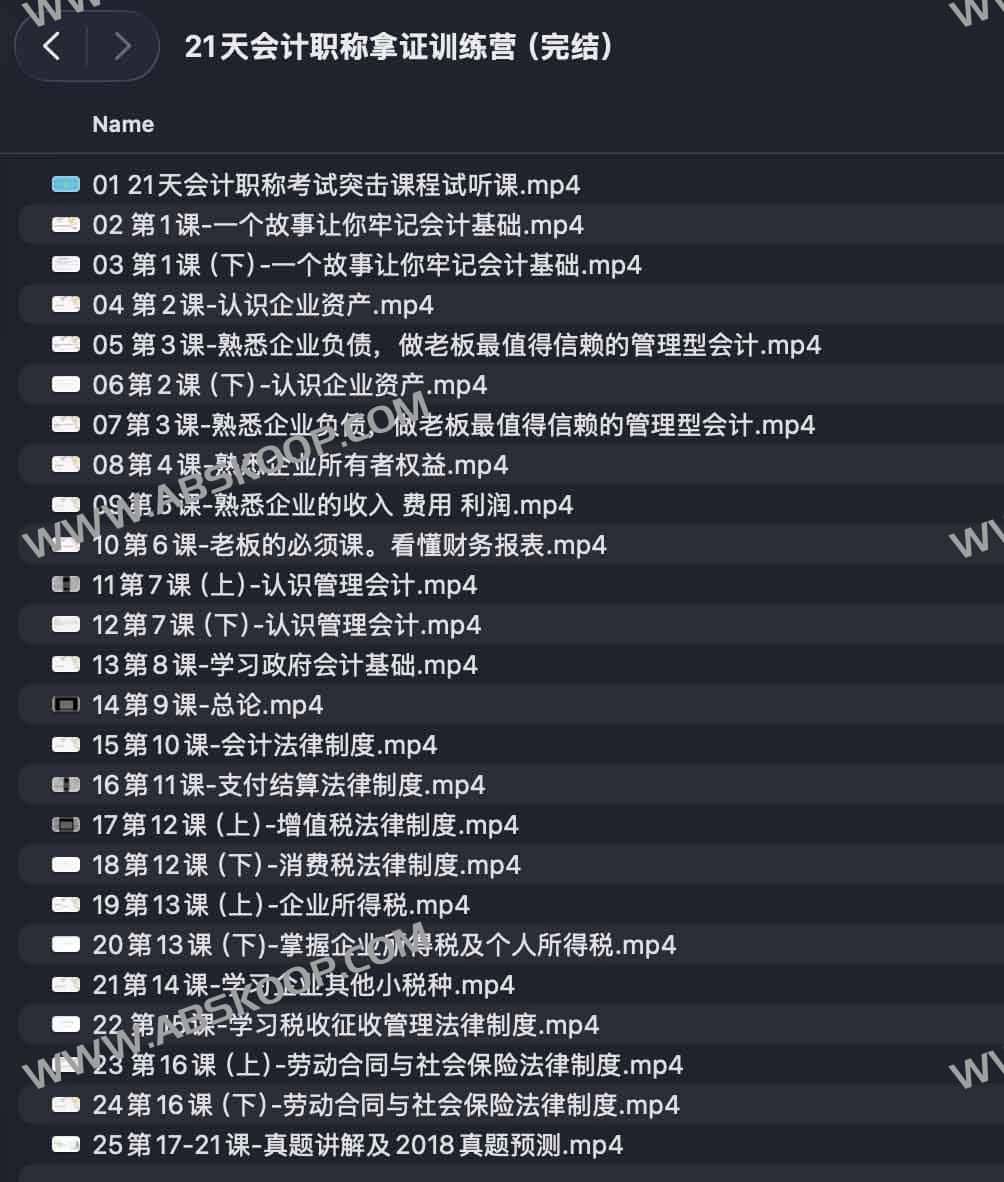
Key takeaways
- Building a knowledge framework: A deep understanding of the accounting element logic of "Assets - Liabilities - Owner's Equity - Revenue/Expenses/Profit".
- Enhance reporting capabilities: Master the skills of interpreting core financial statements such as the balance sheet and income statement, and transform data into support for management decisions.
- Mastering management thinking: Familiar with key modules of management accounting such as cost collection, budget preparation, and performance evaluation.
- Proficient in tax and financial regulations: This document outlines key compliance points for major taxes such as value-added tax and income tax, as well as labor and social security contributions.
- Overcoming the difficulties of the exam: By analyzing past exam questions, we can accurately identify frequently tested points and common pitfalls.
Course Module Details
Phase 1: Accounting Fundamentals and Financial Statement Interpretation (Lessons 1–6)
It focuses on building accounting intuition from scratch, making dry principles more relatable and lowering the barrier to understanding.
- Basic Introduction: Analyzing the basic principles and rules of accounting.
- Subject-specific practical exercises: This document provides a detailed explanation of the identification, measurement, and accounting procedures for assets, liabilities, and owner's equity.
- Profit and loss logic: This study explores the recognition, matching, and profit calculation of revenue and expenses.
- Report Analysis: Learn the structure of core financial statements and practical reading methods.
Phase Two: Management Accounting and Government Accounting (Lessons 7–8)
Shift the focus from accounting to management to understand how financial information drives business operations.
- Management Accounting: Focus on cost control, budget execution, and performance evaluation tools.
- Government Accountant: This study analyzes the accounting characteristics, element structure, and information disclosure requirements of the public sector.
Phase 3: Tax Law and Legal System (Lessons 9–16)
The system outlines the compliance guidelines and tax policies that finance professionals must master.
- Legal norms: It covers accounting laws and regulations, payment and settlement systems, and risk prevention and control.
- Tax Types Explained
- Value Added Tax and Consumption Tax: Detailed explanation of tax obligations, tax base, and key points for declaration.
- Income tax (corporate and individual income tax): Analyze income, deductions, and preferential policies.
- Other taxes: Quickly outline the framework of common minor taxes.
- Tax collection and social security: Learn the tax collection and administration process and understand the boundaries of labor contract signing and social security compliance.
Phase Four: Practice with Real Exam Questions and Prediction of Key Exam Points (Lessons 17–21)
Through practical exercises, knowledge points are transformed into scoring abilities.
- Analysis of past exam questions: Train problem-solving skills and analyze question trends.
- Key points summary: Summarize frequently asked knowledge points and highlight common pitfalls.
Applicable Scenarios
- Exam Preparation Sprint: To prepare for the accounting professional title examination, you need to quickly cover all the test points.
- Workplace tutoring: Newcomers to finance need to quickly establish a tax law framework or strengthen their financial statement analysis skills.
- Knowledge system reshaping: Learners who wish to systematize and structure their fragmented accounting knowledge.
Learning suggestions
- Step by step: It is recommended to follow the path of "basics, reports, management, tax law, legal knowledge, and past exam questions" to build a network from specific points to a broader scope.
- Learning through questions: Each topic is immediately followed by practice questions, with a focus on calculation methods and conceptual boundaries.
- Accurate review: Create a personal error notebook, repeatedly correct any easily confused points, and ensure stability during the exam.
Resource Acquisition
Learning address: Quark Cloud Drive Download
