What is Vibe Coding?
Vibe Coding It is a new programming paradigm advocated by Andrej Karpathy, co-founder of OpenAI. It transforms the traditional "manual coding" into "conversational creation based on natural language," enabling developers (even non-programmers) to quickly turn ideas into working application prototypes by collaborating with AI.
Based on this concept,Vibe Vibe (vibevibe.cn) It was created in response to this need. As the first systematic open-source tutorial for Vibe Coding in China, it aims to break down technical barriers, allowing learners with no prior experience to start from an idea and independently develop and launch a product.
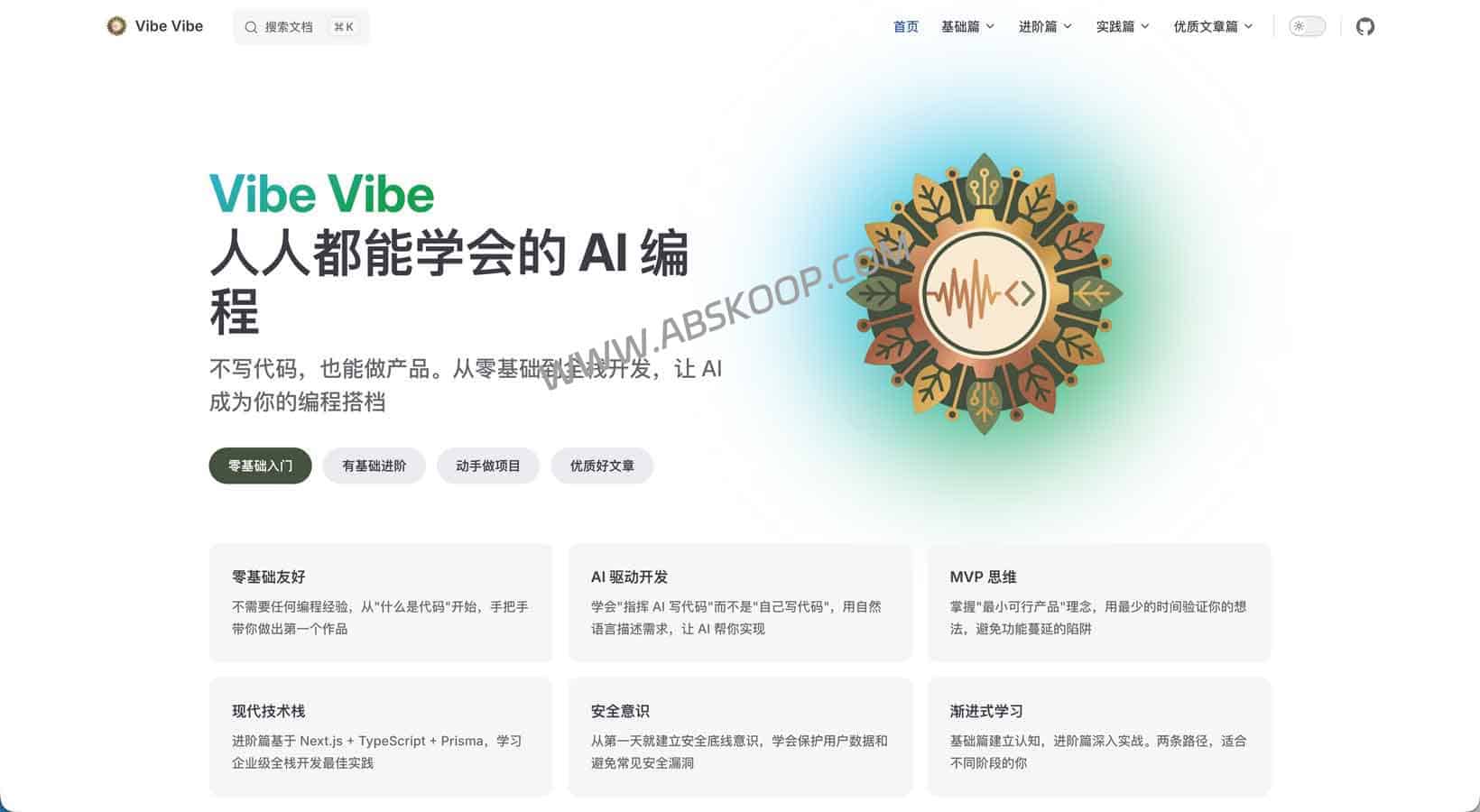
Detailed Explanation of the Tutorial System
This tutorial adopts a hierarchical and progressive structure, dividing the learning path into four core modules, balancing theoretical guidance with practical exercises:
1. Basics: A Quick Start Guide for Beginners
The focus is on cultivating a "product sense" and AI collaboration skills, helping learners independently complete their first web product. It covers natural language-driven coding, MVP (Minimum Viable Product) thinking, and basic deployment processes.
Target audience: Product managers, designers, non-computer science students, and creatives with absolutely no prior experience.
2. Advanced Section: Full-Stack Development in Practice
This course delves into modern software architecture, guiding learners through the complete front-end to back-end chain. Key learning content includes user authentication, database design, API development, and security practices, culminating in a full-process project delivery simulation.
Target audience: Developers or entrepreneurs with some programming skills who wish to master the ability to develop and deploy complete products.
3. Practical Application: Scenario-Based Project Drills
Solidify skills and help learners build a high-quality portfolio by working through practical projects designed for different backgrounds (such as AI Agent development, full-stack SaaS, productivity tools, etc.).
Target audience: Learners who need to deepen their technical application and improve their practical skills through real-world projects.
4. High-Quality Articles: A Global Resource Library
It also includes technical blogs, developer newsletters, and trend reports from leading companies such as OpenAI and Vercel, providing learners with an information channel to connect with the global technology community.
Core Technology Stack (Advanced)
To ensure product modernization and high performance, the advanced version adopts industry-leading development combinations:
- Frameworks and Languages:Next.js + TypeScript
- Interface Development:Tailwind CSS + shadcn/ui
- Data persistence:PostgreSQL + Prisma
- Identity verification:NextAuth.js
- Deployment plan:Docker + Vercel/Edgeone
Why choose the Vibe Coding learning path?
- Zero-barrier start-up: No need to learn complex grammar beforehand; start directly from natural language instructions.
- Structured path: Reject fragmented learning and quickly establish the "idea to product" link through phased goals.
- Dynamically updated: The tutorials are continuously updated and support interactive, visual teaching.
- Open source sharing: Completely free and open source, encouraging community participation and practice.
Resource Entry and Project Background
This project was jointly created by developers and product experts from universities such as Peking University, National University of Singapore, and University of Chinese Academy of Sciences, adhering to a strong open-source spirit and a practical orientation.
📖 Official website address:www.vibevibe.cn
🔗 GitHub Repository:github.com/datawhalechina/vibe-vibe
