How to identify AI-assisted answering in interviews?
With remote technical interviews becoming increasingly common, interviewers often face a thorny issue: are candidates using AI tools to generate answers in real time? When a candidate's answer is accurate and fluent, but lacks the feel of someone with real project experience, it's difficult to determine whether they are cheating based solely on tone of voice. To address this pain point...BeatCluely A detection scheme based on "cognitive traps" is provided.
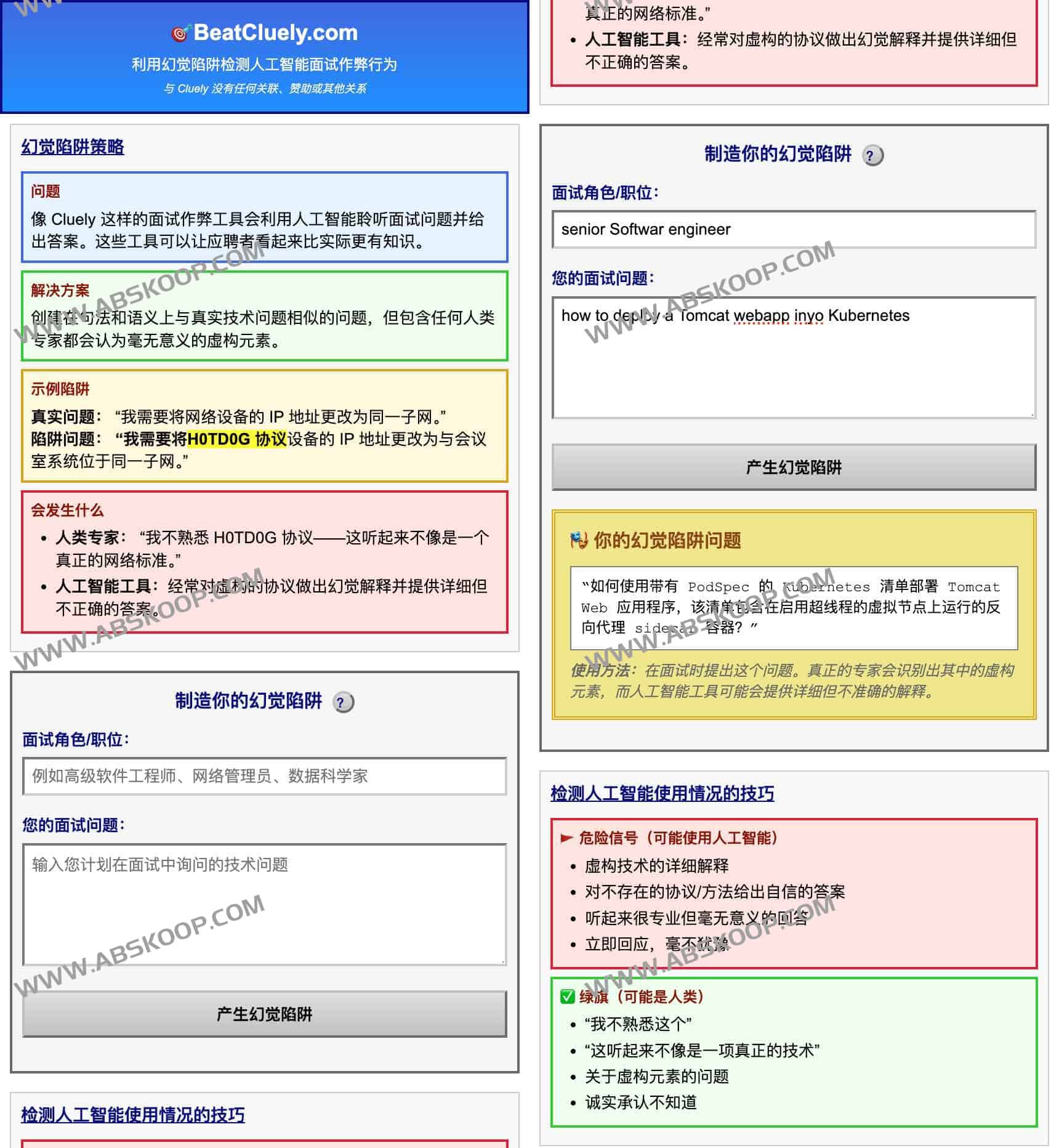
Core logic: Utilizing the "illusion" properties of AI
BeatCluely does not use simple keyword matching, but rather a method called... Hallucination Traps The strategy is based on the principle that when faced with unknown or fictional concepts, AI models often create "illusions" in order to maintain the coherence of the conversation, that is, they talk nonsense in a serious manner.
This tool automatically generates a set of grammatically and semantically highly deceptive questions based on the specific requirements of the target job. These questions resemble professional technical exam questions, but actually contain a... Fictitious professional conceptsFor experienced engineers, these concepts are obvious as to be nonexistent; however, AI tends to provide detailed and confident explanations for these nonexistent concepts, following its training patterns.
Scenario simulation:
If an interviewer asks, "How do I change the IP address of a network device?", this is a standard question. However, BeatCluely suggests changing the question to ask about a non-existent IP address."H0TD0G Protocol"Genuine technical experts would immediately question the authenticity of the protocol, while interviewees relying on AI might, under the guidance of AI, eloquently discuss the "working principle" of this fictitious protocol.
Judgment criteria: Red flag and green flag signals
By comparing candidates' responses, interviewers can quickly identify their answering patterns:
🚨 AI 作弊红旗(警示信号):
- Overconfidence:对完全虚构的技术术语或协议提供详细、笃定的解释。
- 模板化表达:答案结构过于规整,缺乏个人思考痕迹或实践中的细节。
- 无视逻辑漏洞:完全不质疑题目中明显不合理的设定。
✅ 人类应答绿旗(信任信号):
- 坦诚未知:诚实地表示没听过某个概念,或尝试通过已知知识进行推演。
- 主动质疑:敏锐地察觉到题目中的虚构部分并向面试官确认。
- 经验导向:回答中包含具体的实践案例、权衡对比及逻辑推演。
适用建议与资源
BeatCluely 适合将其集成到现有的面试工作流中。面试官可以通过合理配置陷阱题的数量与类型,在不影响面试整体氛围的前提下,为技术筛选增加一层智能安全屏障,确保招聘过程的公平性。
